Thriller Genre Conventions: Essential Scenes Explained
In the thriller genre, obligatory scenes and conventions are the essential storytelling building blocks that evoke specific emotional reactions and meet reader expectations. Think of them as the genre’s unwritten contract with your reader: deliver these, or face one-star reviews and strongly worded emails.
Common elements include:
An Initial Crime. The story kicks off with a crime that signals a master villain is on the loose. Often, this antagonist has been busy before the narrative even starts, racking up a back catalogue of misdeeds the protagonist is yet to discover.
Let’s look at The Girl with the Dragon Tattoo by Stieg Larsson which opens with a decades-old disappearance. Harriet Vanger has been missing for forty years, which immediately signals that the villain has had a very long head start. I found the opening of this book so intriguing; I had to keep reading.
The Master Villain. Thrillers demand a clever, powerful antagonist, whether that’s a savvy criminal, a serial murderer, or a tech billionaire with a god complex. This character operates beyond the realm of reason and cannot be talked out of their plans, no matter how persuasively your protagonist argues.
Anton Chigurh (No Country for Old Men) is arguably the purest example of a villain who operates entirely outside reason. He has his own philosophy, his own code, and absolutely no interest in negotiating. He is not a man you talk down. He is a force of nature with a bolt pistol.
Of course, your master villain doesn’t have to be like Anton Chigurh. For a literary example, Tom Ripley in Patricia Highsmith’s The Talented Mr. Ripley is a different flavour entirely: charming, calculating, and terrifyingly plausible. The horror isn’t that he’s a monster. It’s that he isn’t!
At Least One Victim. Someone must be on the receiving end of the antagonist’s crime, whether that’s a hostage, a missing person, or an entire city held to ransom.
For example, I Am Pilgrim by Terry Hayes opens with an unidentified woman found dead in a New York hotel room, her face dissolved in acid(nice). One victim, efficiently rendered anonymous.
But let’s look at another example that doesn’t fit snugly into the ‘At least one victim’ criteria: Room by Emma Donoghue begins with Jack and his mother already captive, already years into their imprisonment. The victim is the entire world of the novel. There is no before.
Clues and Red Herrings. The protagonist follows a trail of information that includes genuine clues leading toward the truth and red herrings designed to misdirect both the hero and the reader. The best red herrings make you feel delightfully cheated. You thought you had it sussed… but you didn’t.
Agatha Christie’s And Then There Were None is the gold standard of red herrings. Ten suspects, ten potential killers, no obvious culprit, and a solution that remains genuinely shocking even on a second read (or on audible like me) when you know exactly where to look.
Slight spoiler alert for The Silent Patient by Alex Michaelides Red herrings don’t have to be woven into the story at specific plot points; in The Silent Patient by Alex Michaelides, the entire novel functions as an extended red herring. The reader is confidently pointing at the wrong person right up until the final pages, at which point the rug is pulled out with considerable force.
A Speech in Praise of the Villain. At some point, characters must pause to discuss just how brilliant, dangerous, or terrifyingly well-organised the antagonist is. This isn’t admiration, it’s a warning shot.
In Zodiac (the Robert Graysmith non-fiction account that reads like a thriller), the sheer volume of law enforcement bafflement at the killer’s methods functions as an extended tribute to his evasiveness. Entire careers were broken trying to catch him.
The MacGuffin. The antagonist needs something, whether that’s a briefcase, a formula, a memory stick, or the nuclear codes. Their pursuit of this specific object or goal drives the plot forward.
Here’s an example from one of my favourite books: The Firm by John Grisham. The MacGuffin is the files that prove the firm’s criminal activity. Mitch McDeere spends the novel trying to get hold of them before either the FBI or the Mafia gets hold of him. The files don’t particularly matter in themselves. What matters is who has them.
The Shape-Shifter. Thrillers typically feature a character who says one thing and does another entirely. Their deceptive behaviour directly impacts the protagonist’s mission and keeps the reader perpetually suspicious of everyone, including the dog.
But the shape-shifting can involve more than just a character. In Behind Closed Doors by B A Paris: Jack Angel presents as the perfect husband. The shape-shifter here is the entire marriage, and the reveal of what lies behind the façade is one of the more quietly devastating in recent domestic noir.
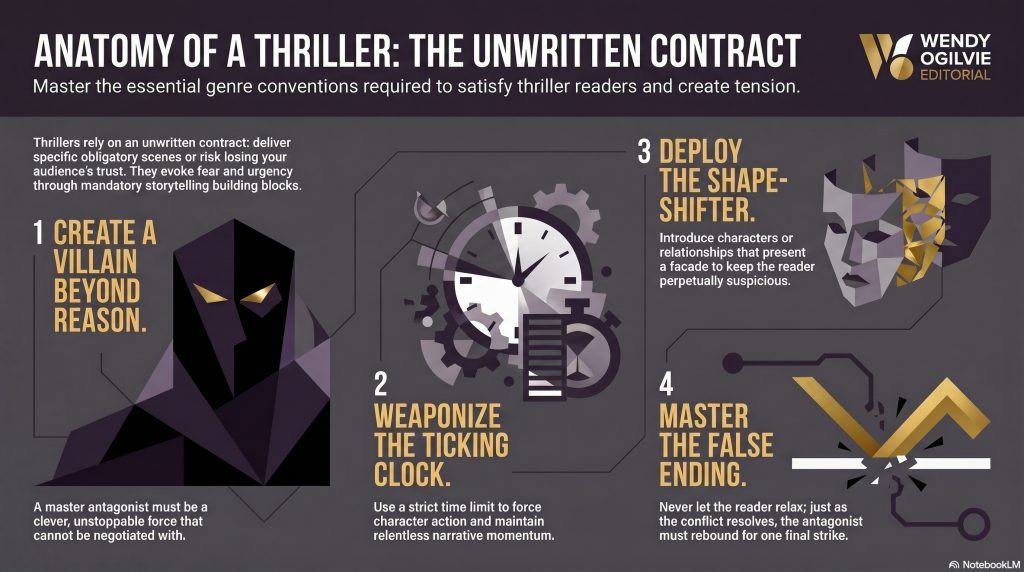
A Ticking Clock or Deadline. Urgency is everything. A specific time limit forces the protagonist to act, and forces the reader to keep turning pages long past a sensible bedtime. It could be a literal ‘ticking clock’ or a deadline with the emphasis on the word ‘dead’. Here are a couple of examples:
61 Hours by Lee Child: Jack Reacher investigates a murder while the reader is presented with a literal countdown of 61 hours before a major, unknown event occurs.
Falling by T J Newman is almost nothing but ticking clock. A pilot’s family has been kidnapped and he is told to crash the plane or they die. Every page is the clock. There is no subplot that isn’t the clock.
Multiple Lives at Stake. Thrillers operate in the realm of life-and-death stakes. Unlike mysteries, where the protagonist is largely an observer piecing things together, here their own life is typically on the line during the final confrontation.
World War Z by Max Brooks, structured as a post-event oral history, tells you upfront that civilisation almost ended. The stakes were as high as they get, and the novel works backwards from that near-catastrophe.
The False Ending. Just when the conflict appears resolved and the reader exhales, the antagonist rebounds for one final challenge. Never let them relax too soon.
In The Silence of the Lambs by Thomas Harris, Clarice calls Jack Crawford to report her lead in Ohio, only to be told the FBI has already found Buffalo Bill and is closing in. When they knock down the door, the house is empty. Meanwhile, Clarice is on the wrong doorstep entirely, and Buffalo Bill is standing right in front of her. Duh, duh, duh! Great stuff.
I’ve included a range of examples to show how different authors have taken familiar conventions and subverted them in interesting ways.
Writers are encouraged to approach these moments with fresh, unexpected choices, sidestepping cliché while still delivering the emotional payoff readers expect from the genre. The conventions are the bones. Think of the rest as your creative playground.
Want Help Strengthening Your Thriller?
If you’re working on a thriller and want expert feedback on structure, pacing, or tension, explore my:
– Manuscript Evaluation
– Book Editing Services
Or get in touch to discuss your project.
Frequently Asked Questions About Thriller Genre Conventions
What are genre conventions in a thriller?
Genre conventions in a thriller are the essential story elements that create tension, urgency, and high stakes. These typically include a central crime, a powerful antagonist, a ticking clock, and a life-or-death climax.
What is the difference between tropes and genre conventions?
The difference is simple. Genre conventions shape the structure of a story, while tropes add familiar patterns within that structure. Conventions are required for the genre to work. Tropes are optional and flexible.
Do thrillers need to follow genre conventions?
Yes, most thrillers need to follow genre conventions to meet reader expectations. Without them, the story may not feel like a thriller, even if the premise suggests it should.
Can you break genre conventions in a thriller?
Yes, you can break genre conventions in a thriller, but only if you still deliver the expected emotional payoff. Removing tension or stakes entirely will weaken the story.
What creates tension in a thriller?
Tension in a thriller comes from high stakes, time pressure, and uncertainty. Elements like a ticking clock, escalating danger, and hidden motives keep readers engaged.
Are genre conventions the same as story structure?
No, genre conventions and story structure are not the same. Story structure is the overall framework of a narrative, while genre conventions are the key moments that deliver the genre’s emotional experience.