
Levels of Editing: A Simple Guide for Fiction Writers
Congratulations! You’ve typed THE END on the first draft of your novel. Now the real work begins.
Levels of editing can feel confusing when you are writing your first book. Many writers assume editing simply means correcting grammar or spelling. In reality, editing happens in stages, and each stage serves a different purpose.
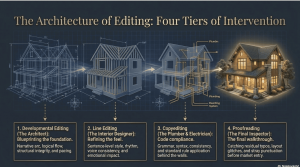
One helpful way to think about it is this: writing a book is like building a house. You would not start adding posh cushions before the walls were up and the roof was secure. In the same way, each level of editing builds on the stage before it.
Understanding the levels of editing helps you decide what your manuscript actually needs right now, rather than paying for the wrong service too early.
Developmental Editing – The First Level of Editing and the Story Foundations
The first of the major level of editing is developmental editing, sometimes called structural editing.
Before a house can stand, it needs solid foundations and a clear architectural plan. Developmental editing focuses on exactly that. So, what does that mean for Crime or Romance novels?
Crime Fiction
In crime fiction, structure is everything.

This stage focuses on:
- Plot logic and causality
- Clue placement and red herrings
- Pacing and escalation of tension
- Suspect development and motive
- Credibility of investigation procedures
- A satisfying and believable resolution
Crime readers notice inconsistencies. If a clue appears too conveniently or a suspect’s motivation feels thin, the tension collapses.
Developmental editing ensures your story’s framework is watertight. The timeline holds. The twists land. The ending earns its impact.
This is right for you if:
- Beta readers say they were confused
- The middle sags or feels repetitive
- The twist feels predictable or unearned
- You worry about plot holes
Romance Fiction
In romance, the emotional arc matters just as much as plot.

This stage focuses on:
- The relationship arc from meeting to resolution
- Character growth and emotional motivation
- Conflict that genuinely challenges the couple
- Pacing of attraction and tension
- Genre conventions and reader expectations
- A satisfying happily ever after or happy for now
If the conflict feels forced or the chemistry is underdeveloped, readers disengage.
Structural editing ensures the emotional beats land where they should. The stakes feel real. The resolution feels earned.
This is right for you if:
- The relationship feels rushed or flat
- Beta readers are not emotionally invested
- The conflict seems repetitive or weak
- The ending lacks emotional impact
If the layout doesn’t work, no amount of sentence polishing will fix it. Developmental editing ensures your manuscript is structurally sound before you move on to the next level of editing.
What you gain from this level of editing is clarity, direction, and confidence in the bones of your story.
Copyediting and Line Editing – The Second Level of Editing
Once the structure is secure, the next level of editing focuses on the writing itself.
If developmental editing builds the house, copyediting and line editing are like fitting the doors, smoothing the plaster, and making the rooms feel comfortable to live in.
This stage focuses on:
-
Sentence clarity and flow
-
Grammar, punctuation, and spelling
-
Consistency of voice and tone
-
Word choice and repetition
-
Style and readability
Professional editors will often follow recognised style guides to ensure consistency and accuracy throughout your manuscript.
This level of editing is right for you if:
-
You feel confident in your story’s structure
-
Your manuscript reads well but could sound smoother
-
You are preparing the book for submission or publication
Copyediting improves the writing without changing your voice. It simply makes the prose clearer and more polished.
Proofreading – The Final Level of Editing Before Publication
Proofreading is the final stage in the levels of editing process.
Think of it as the last walk-through before handing over the keys to the house.
At this point the big work is finished. The structure is solid and the rooms are decorated. Now it is time to catch any small details that might have been missed.
Proofreading focuses on:
-
Typographical errors
-
Minor punctuation slips
-
Formatting inconsistencies
-
Small details that distract readers
The structure is finished. The decorating is done. You have been to Ikea and added your cushions.
Proofreading ensures nothing small undermines all the hard work that came before.
This stage is best for manuscripts that have already been fully edited and are almost ready to publish or submit.
Coaching – A Different Approach Within the Levels of Editing
Coaching sits slightly outside the traditional levels of editing, but it can be incredibly valuable for writers who want to improve their craft.
Instead of stepping in to fix the house for you, coaching helps you learn how to build it more confidently yourself.
Through coaching you learn:
-
How to identify structural weaknesses early
-
How to self-edit more effectively
-
How to strengthen clarity and flow
-
How to avoid common writing pitfalls
Over time this leads to fewer costly revisions and a stronger manuscript before you even reach the formal editing stages.
It’s especially valuable for newer writers or anyone who wants to build long-term editing skills alongside improving their current manuscript.
How to Choose the Right Level of Editing
If you are unsure which of the levels of editing your manuscript needs, start by asking yourself a few simple questions.
-
Is my story structure solid?
-
Does the plot contain enough conflict and tension?
-
Does the story have a satisfying ending?
-
Does the writing itself need refinement at sentence level?
-
Has the manuscript already been professionally edited?
-
Would I benefit from learning how to self-edit more confidently first?
Most manuscripts move through several levels of editing, just as a house is built in phases.
The key is starting where your manuscript truly is, not where you hope it might be.
Final Thought
Editing is not about criticism. It is about strengthening what you have built so readers can step inside your story and stay there.
Understanding the levels of editing helps you approach the process with confidence and choose the support that will make the biggest difference to your manuscript.
If you’re unsure which stage your manuscript is at, you are welcome to complete the self-assessment questionnaire or get in touch for tailored guidance.