
1. When Your Subplot Starts Taking Over the Investigation
Your detective or investigator’s marriage is on the rocks, his mother rang to say his dad is missing, and his colleague at work is hiding something. Meanwhile, someone really ought to investigate that dead body.
Subplots in crime fiction can give your novel depth, but they can also interrupt the investigation or leave the poor reader wondering which story they’re following. I recently likened this to a guide taking you through the forest to see the magical waterfall. Would you follow the pensive-looking guide who’s still looking at his map every time he takes you down another path, or would you prefer the confident guide who tucks her map into her pocket and marches off in the direction you need to go for the best experience?
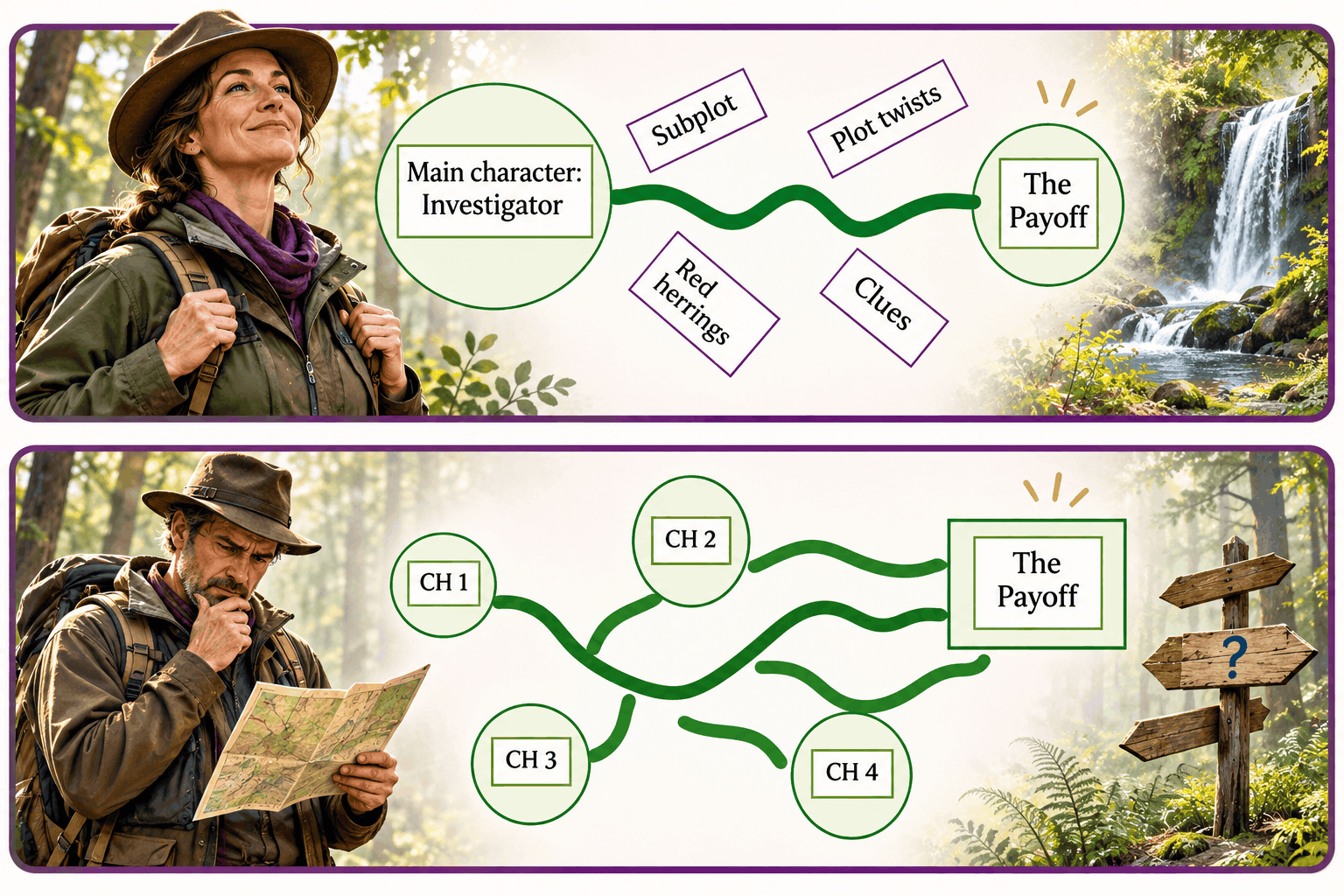
In this article, we’ll look at what a subplot is and why it belongs in your story before troubleshooting subplot issues. And, as always, I have some homework for those of you who would like to audit your own subplots.
For a wider look at how storylines fit together, see my guide to story structure for fiction writers.
Quick Navigation
- Quick Answer
- What Counts as a Subplot in a Crime Novel?
- Give Every Subplot a Reason to Be There
- Connect the Subplot Through Choices and Consequences
- Give the Subplot Its Own Progression
- Keep the Central Mystery Moving
- Subplots, Red Herrings and Reader Expectations
- Resolve Subplots Without Crowding the Ending
- Common Crime Subplot Problems and How to Revise Them
- Your Homework! A Crime Subplot Audit
- FAQs
- Give Every Thread a Purpose
3. What Counts as a Subplot in a Crime Novel?
A subplot is a secondary storyline that develops alongside your main plot. It raises a question of its own and gives the reader a reason to follow it. In a crime novel, the main question might be ‘Who killed the victim?’ while a subplot asks ‘Can the detective repair her relationship with her daughter?’
Let’s say your detective, DI Ellis, has a teenage daughter who’s fed up with Ellis cancelling plans. A passing mention that Ellis missed last year’s school concert gives us backstory. But when Ellis promises to come to this year’s concert, follows a promising lead instead and discovers her daughter has stopped asking her to show up, you’ve got the beginnings of a subplot. There’s a promise, a choice and a consequence. Now we want to know what Ellis will do about it.
The distinction gets trickier when a secondary thread involves a suspect. Imagine a witness lies about where she was on the night of the murder. The detective checks her story and discovers she was secretly meeting her estranged sister. If that discovery simply explains the lie and clears up a gap in the timeline, it’s part of the investigation. If the sisters’ reunion leads to further choices and consequences that play out across the novel, their relationship may also become a subplot.
Once you know which threads are subplots, you can ask what each one adds to your crime novel. That’s where the fun begins.
4. Give Every Subplot a Reason to Be There
A subplot can do several jobs in a crime novel.
| Purpose | Crime fiction example |
|---|---|
| Increase the personal stakes | The investigation threatens a relationship the detective is trying to repair |
| Complicate decisions | Protecting a colleague conflicts with following the evidence |
| Reveal character | A family dispute exposes the protagonist’s need for control |
| Explore theme | A secondary storyline offers another perspective on justice or loyalty |
| Broaden the consequences | A victim’s family faces difficulties that continue beyond identifying the killer |
| Create competing pressures | Another case demands attention at a crucial moment |
Revision question – If you removed this thread, what would readers lose?
5. Connect the Subplot Through Choices and Consequences
DI Ellis has promised to attend the school concert. A promising lead comes in late. She decides to follow it herself and misses the performance. When she tries to make it up to her daughter the next morning, her daughter tells her she’d already asked her aunt to come. She was counting on someone else.
That one decision gives you several ways to connect the two storylines.
| Connection | How it might work |
|---|---|
| Time | The concert and the chance to speak to a witness fall on the same evening. The detective has to decide who’ll handle the interview. |
| Judgement | Hearing why her daughter stopped asking for help makes the detective reconsider why a witness went quiet after being let down. |
| Trust | The daughter stops sharing things that matter to her because she’s tired of being disappointed. |
| Choices | Following the lead brings in new information, but the broken promise makes it harder to repair the relationship. |
| Theme | At home and at work, the detective faces the same question. What does it take to earn back someone’s trust? |
Pick the connections that come naturally from your characters’ choices. The daughter can matter to the novel without ever setting foot in the incident room.
6. Give the Subplot Its Own Progression
A subplot can develop over a handful of scenes. Use these four steps to see whether the situation is moving.
- Establish. Ellis wants to be more present in her daughter’s life. The concert is the first thing her daughter has invited her to in months.
- Complicate. She misses it. When she apologises, she discovers her daughter had already made a back-up plan.
- Turn. When a late interview clashes with a second commitment, Ellis asks a colleague who knows the case to handle it. She has to trust them to pick up on anything she might have spotted herself.
- Pay off. Ellis turns up when she said she would. Afterwards, her daughter asks whether they can do it again next week.
You can spread those developments across the novel or let two happen in the same scene. There’s no fixed scene count or need for a miniature three-act structure.
Revision question – Does each appearance change the situation, or are we watching the same argument in a different kitchen?
If you’re working with two timelines as well, see my guide to writing a dual-timeline mystery.
7. Keep the Central Mystery Moving
Before you switch threads, ask what question is pulling the reader forward. If the detective has just asked a witness to explain a glaring inconsistency, readers will expect an answer soon. If an interview has already closed off one line of enquiry, a quieter scene can give the reader room to absorb that setback and see what else the investigation is costing.
You can also move both threads in one scene. Ellis briefs her colleague before leaving to meet her daughter. As she explains what she wants the colleague to ask, she realises she’s been taking part of the witness’s account for granted. The handover changes the direction of the interview and shows Ellis keeping her promise.
Sometimes a quiet scene simply needs to show what’s changed. The morning after the concert, the daughter’s admission about inviting her aunt as back-up earns its place because it changes what Ellis understands about their relationship.
For more on scene placement and revelations, see How to Create Suspense in Crime Fiction.

8. Subplots, Red Herrings and Reader Expectations
A subplot is a storyline. A red herring is something that leads the reader towards a mistaken conclusion. A subplot can also misdirect the reader.
Suppose a witness lies about where they were on the night of the murder. The detective suspects they’re protecting the killer. In fact, the witness went to see their estranged brother about a family dispute and wanted to keep the visit private. Finding out where they were clears up the inconsistency. It also forces the siblings to reckon with the fact that one of them was prepared to deny seeing the other.
The more space you give that lie, the more readers will expect its explanation to matter. Give the witness a believable reason to keep the secret and show what changes once it comes out.
Revision question – Once the reader knows the truth, does this thread still feel worth including?
9. Resolve Subplots Without Crowding the Ending
You can resolve a secondary thread before the climax, let it influence the climax or show its consequences in the aftermath. Place the payoff where the choice or change will carry the most weight.
In Ellis’s story, asking a colleague to handle the interview can happen before the climax. The daughter’s invitation to meet again can come after the case is over. It’s a small moment, and it gives readers an answer to the question the subplot raised. Is she willing to give her parent another chance?
If a subplot helps solve the crime, establish the relevant knowledge or relationship earlier. A colleague’s insight will feel earned if readers have already seen what that colleague brings to the investigation.
In a standalone, the invitation might be all the closure the relationship needs. In a series, rebuilding trust can continue across several books, but readers still need to see a shift in this one.
Revision question – Have you answered the particular question this subplot raised, even if the character’s wider life remains complicated?
10. Common Crime Subplot Problems and How to Revise Them
| Problem | What to check | Possible revision |
|---|---|---|
| The personal storyline takes over | Is the mystery getting enough development? | Trim repeated scenes or reconsider which thread is the main plot. |
| The subplot disappears | Is there a missing development or consequence? | Restore the moment where readers would naturally expect it. |
| Every thread connects to the killer | Do those connections feel believable? | Let some threads shape character choices or develop the theme. |
| The same conflict repeats | What changes each time it comes up? | Combine scenes or let an earlier choice have a new consequence. |
| The subplot solves the case too conveniently | Have you established the relevant knowledge or connection? | Set it up earlier or revise how the case is solved. |
| The subplot fizzles out | What outcome have you led readers to expect? | Give it a proportionate payoff or reduce its prominence. |
For more help with revision, see The Middle Draft Roadmap.
12. FAQs
Does every crime novel need a subplot?
No. A tightly focused mystery can sustain a novel on its own. Add a subplot if it gives readers something meaningful to follow alongside the case.
How many subplots can a crime novel support?
As many as you can develop and pay off while giving the central mystery the attention it needs. If several threads go quiet for long stretches or all need resolving in the final chapter, look at which ones could be combined or trimmed.
Does every subplot need to connect to the crime?
A subplot can contribute through character, theme or consequences. Ellis’s relationship with her daughter matters because it changes how she makes decisions under pressure.
What’s the difference between a subplot and a red herring?
A subplot develops over time. A red herring invites a mistaken inference. A subplot can create a red herring, as when a witness’s private troubles give them a believable reason to lie.
Can a detective’s personal storyline continue across a series?
Yes. An ongoing relationship can give readers another reason to return. Give it a meaningful development in each book, even if the larger question takes longer to resolve.
13. Give Every Thread a Purpose
Readers may pick up your novel to find out who committed the crime. By the end, they may care just as much about whether Ellis keeps her next promise. Give the lives unfolding around the investigation room to affect what people do, what they risk and what happens next.
If you’d like an editorial eye on how your storylines work together, you can explore my Manuscript Evaluation or Full Developmental Edit.