
Story Structure for Fiction Writers: How to Build a Stronger Story
A strong story needs more than interesting characters and a promising
idea. It needs a structure that guides the reader through the beginning,
middle and end, while allowing the conflict, character development and
tension to build naturally.
In this guide, we’ll look at what story structure means, why it
matters and how you can use it to create a satisfying novel without
making your writing feel rigid or predictable.
There’s also a simple manuscript checklist at the end to help you
identify any areas of your own story that might need further development
or tweaking.
Quick Answer
Story structure is the framework that holds a narrative together. It
organises the important events and turning points so that the plot
progresses, the characters develop and the reader remains engaged.
Structure isn’t a formula that every novel must follow exactly. It’s
a way of understanding how the different parts of your story work
together to create a complete and satisfying reading experience.
What Is Story Structure?
Story structure turns a collection of scenes, events and ideas into a
complete narrative.
A good idea alone isn’t enough to guarantee a satisfying novel. You
might have an intriguing premise, compelling characters and an
atmospheric setting, but the story can still feel slow, disjointed or
incomplete if its events aren’t connected effectively.
Structure determines:
- Where the story begins
- What disrupts the protagonist’s ordinary life
- How the central conflict develops
- When major decisions and turning points occur
- How the stakes increase
- Where the story reaches its climax
- How the central conflict is resolved
Writers of crime, thriller, mystery and romance fiction also need to
consider the conventions and expectations of their chosen genre. A crime
reader usually expects the mystery to develop through a series of
discoveries, complications and revelations. A romance reader expects the
central relationship to progress towards a satisfying emotional
resolution: our HEA (happily ever after) or HFN (Happy for now).
These expectations can help a writer shape the story, but they
shouldn’t be treated as inflexible rules.
Literary fiction may follow less obvious structural patterns, but it
still needs an underlying shape or spine. That spine might be formed by
a character’s emotional development, a central relationship, a recurring
question or a gradual change in circumstances rather than a conventional
action-driven plot.
Planning can help you establish this framework before you begin
writing. However, if you’re a ‘pantster’ who prefers to find the story
during the drafting process, you can examine and strengthen its
structure during revision.
Simple Writer Tip
Think of structure as the shape of your story rather than a set of
rules. It helps you understand how each important event, choice and
consequence leads to the next.
What Is the
Difference Between Plot and Structure?
I’m asked this quite often, so I’ve included the table below to make
the distinction clearer.
| Plot | Structure |
|---|---|
| What happens in the story | How those events are arranged |
| The actions, discoveries and consequences | The framework connecting those events |
| Specific to your novel | Can follow a recognisable storytelling pattern |
| Answers ‘What happens?’ | Answers ‘Why does it happen here?’ |
Example
Imagine a mystery novel in which a detective discovers a missing key,
questions the victim’s neighbour and learns that the neighbour entered
the house on the night of the murder.
If the missing key is discovered first, the neighbour’s evasive
answers immediately appear suspicious. The story encourages the reader
to see them as a possible culprit.
If the questioning happens before the key is found, the conversation
may seem unimportant at first. When the key is discovered later, the
reader is forced to reconsider the neighbour’s earlier answers and
search them for hidden meaning.
The plot events remain the same, but their placement changes what the
reader suspects and when.
Why Does Story Structure
Matter?
Structure gives your story direction. It helps the reader understand
what the protagonist is trying to achieve, what stands in their way and
why each development matters.
Readers may not consciously identify a novel’s structure while
they’re reading, but they’ll usually notice when a story lacks momentum
or direction. They might say that the middle dragged, the climax
appeared suddenly or the ending felt unsatisfying.
A strong structure helps you:
- Give the story a clear sense of direction
- Connect scenes through cause and effect
- Maintain momentum
- Develop conflict and tension
- Create believable character change
- Control the release of information
- Build towards a satisfying climax
- Deliver an ending that feels earned
Cause and effect are particularly important. One event should
influence what happens next.
For example, the protagonist makes a decision, that decision creates
an unexpected consequence and the consequence forces them to make
another, more difficult choice. This creates a chain of connected events
that moves the story forward.
Without this connection, scenes can begin to feel episodic.
Interesting things might happen, but the reader can’t see how those
events contribute to the larger story.
Structure also helps you control the reader’s experience. In a
mystery, it determines when clues and revelations appear. In a romance,
it influences when the characters grow closer, when obstacles separate
them and when they confront the problem preventing them from being
together.
What Are the Main Stages of
a Story?
There are many different structural models, including the three-act
structure, the Hero’s Journey, Save the Cat! and the seven-point story
structure. We’ll explore some of these approaches in later articles.
For now, it’s useful to think of a story in three broad stages: the
beginning, middle and end.
1. The Beginning
The beginning introduces the protagonist and establishes their
situation before the main conflict develops.
It usually needs to:
- Introduce the protagonist
- Establish what they want or need
- Present the central problem
- Give the protagonist a reason to act
- Move them into the main story
Your opening doesn’t have to explain everything about the characters
or the world. It does, however, need to give the reader a reason to keep
reading.
At some point, an event or revelation should throw your protagonist’s
world off its axis. A body is discovered. A new employee arrives. A
relationship ends. A secret is revealed. A character receives an
opportunity they can’t ignore.
This event or revelation gives the story direction by creating a
problem, goal or question that must be addressed.
2. The Middle
The middle develops the central conflict and tests the
protagonist.
It usually involves:
- Introducing complications
- Increasing the stakes
- Revealing new information
- Forcing the protagonist to make difficult choices
- Allowing them to experience successes and failures
- Developing relationships and subplots
- Building towards a major confrontation
The middle is where many manuscripts begin to lose momentum. This
often happens when the protagonist reacts to a series of events without
making meaningful decisions of their own.
To maintain momentum, complications should do more than delay
the protagonist. They should change the situation.
A new clue might undermine the detective’s theory. A romantic
interest might reveal something that damages the other character’s
trust. An apparent success might create a more serious problem.
Each development should increase the pressure and make the
protagonist’s next decision more difficult.
3. The End
The final section brings the central conflict to its most important
confrontation and reveals the consequences of the protagonist’s
choices.
It usually needs to:
- Bring the central conflict to a climax
- Require the protagonist to make a decisive choice
- Show the consequences of that choice
- Resolve the most important story questions
- Complete the protagonist’s emotional journey
- Give the reader a satisfying sense of closure
A satisfying ending doesn’t necessarily have to be happy or neatly
resolve every subplot. It should, however, address the central conflict
established by the story.
The climax should also grow naturally from everything that came
before it. If the protagonist suddenly develops a new ability, receives
unexpected help or discovers a convenient solution, the ending may feel
unearned and disappointing for your readers.
The strongest endings allow the protagonist to use what they’ve
learnt, confront what they’ve avoided or make a choice they wouldn’t
have been capable of making at the beginning.
How Does
Structure Support Character Development?
Plot events shouldn’t simply happen around the protagonist. They
should challenge them and require a response.
The external plot concerns what the protagonist is trying to achieve.
The internal character arc concerns how their experiences change
them.
These two elements are often closely connected:
- The beginning establishes who the protagonist is.
- The developing conflict tests their beliefs, strengths and
weaknesses. - Turning points force them to make increasingly difficult
decisions. - The climax demonstrates whether and how they have changed.
- The resolution reveals the consequences of that change.
Imagine a detective who refuses to trust anyone because a former
colleague betrayed her. At the beginning of the novel, she insists on
working alone. As the investigation becomes more dangerous, this choice
begins to limit her progress and place other people at risk.
At the climax, she must decide whether to trust her new partner with
a crucial piece of evidence. Her external decision contributes to
solving the crime, but it also demonstrates her internal
development.
The plot and character arc support each other. Without the
investigation, she would have no reason to confront her fear of trusting
others. Without her internal conflict, solving the case would have less
emotional significance.
However, not every protagonist needs to undergo a dramatic
transformation. In Agatha Christie’s Murder on the Orient
Express, Hercule Poirot remains largely the same observant and
principled detective throughout the novel. However, what he uncovers
forces him to make a morally significant decision that affects everyone
involved. A protagonist may remain personally consistent while their
choices still create meaningful consequences for other characters and
the wider story. Sherlock Holmes would be another example.
Does Story
Structure Make a Novel Predictable?
If you’re worried that using structure will make your work formulaic,
don’t be; structure provides shape, not content.
Think about houses. Many share the same basic elements, including
walls, doors, windows and a roof, but they can still look and feel
completely different. Their character comes from the way those elements
are designed and combined.
Stories work in much the same way.
Two novels might both include an inciting incident, a midpoint
reversal and a final confrontation, but they can still be entirely
different because of their:
- Characters
- Conflicts
- Settings
- Themes
- Relationships
- Narrative voices
- Emotional journeys
- Outcomes
Predictability usually comes from obvious outcomes, weak
complications or characters who make familiar choices without convincing
personal reasons. It doesn’t come from giving a story a clear beginning,
middle and end.
Genre readers often enjoy certain structural expectations. Romance
readers generally want the central relationship to receive a satisfying
resolution. Mystery readers expect the central puzzle to be
explained.
Meeting those expectations doesn’t mean every stage of the journey
must be obvious. The originality comes from how your particular
characters reach that destination.
Common Signs
That a Story Has Structural Problems
Structural problems can appear in many different ways. You may
recognise one or more of the following:
- The opening takes too long to reach the central conflict.
- The protagonist has no clear goal.
- Scenes feel episodic or disconnected.
- Events happen through coincidence rather than cause and effect.
- The protagonist reacts but rarely makes meaningful choices.
- The middle loses momentum.
- The stakes remain unchanged.
- Major turning points happen too easily.
- New information appears without sufficient preparation.
- Subplots distract from the main story.
- The climax feels rushed or arrives too late.
- The ending doesn’t resolve the central conflict.
- The protagonist’s final actions don’t reflect their
development.
One of these signs doesn’t necessarily mean the entire structure has
failed. It may indicate that a particular section needs more development
or that the connection between two important events isn’t yet clear.
Important
A structural problem can’t always be solved by rewriting individual
sentences. Sometimes scenes need to be moved, expanded, combined or
removed. When working on a developmental/structural edit for a client, I
will separate each scene (In Scrivener) so the structure can be easily
be adjusted and tested before a final decision is made.

When Should You
Review Your Story Structure?
The best time to consider structure depends partly on your writing
process.
Before Drafting
Writers who enjoy planning can use a loose structure to identify the
story’s main turning points and character decisions before drafting.
You don’t need to plan every scene. You might begin by
identifying:
- The event that starts the main story
- The protagonist’s central goal
- The main obstacles
- A significant midpoint development
- The decision that leads towards the climax
- The likely resolution
This provides direction while leaving room for the unexpected journey
your characters might take you on.
During Drafting
A simple structural check can help if you become stuck or lose sight
of the story’s direction.
Ask yourself:
- What does the protagonist want at this point?
- What is preventing them from getting it?
- What has changed since the previous major event?
- What decision must they make next?
- How will that decision affect what follows?
You don’t need to stop and restructure the entire manuscript whenever
you encounter a problem. A few notes may be enough to help you continue
drafting without losing the idea.
After the First Draft
After the first draft is usually the best time for a detailed
structural review. You can assess the complete story before
concentrating on sentence-level editing.
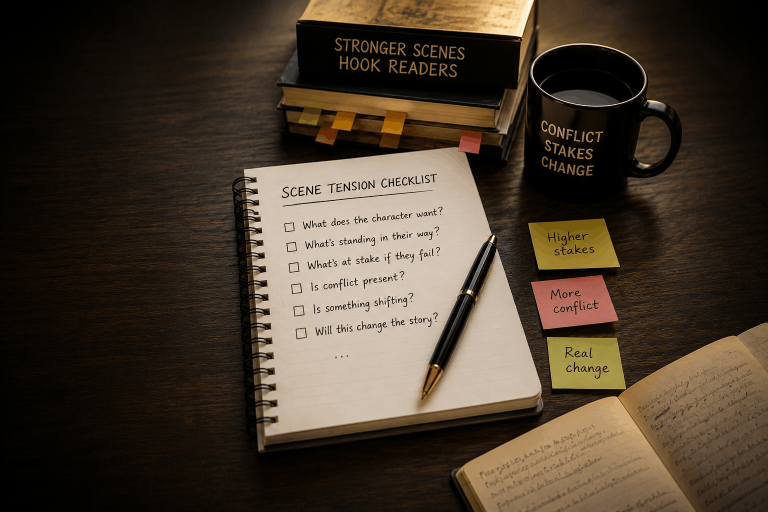
Creating a scene list or story map can make the structure easier to
see. For each scene, record:
- The scene’s purpose
- The viewpoint character
- The character’s goal
- The central conflict
- What changes during the scene
- How the scene affects what follows
If you can’t identify what changes or how a scene influences later
events, consider whether it needs to be strengthened, combined with
another scene or removed.
A Simple Story Structure Check
Use the following questions to examine the foundations of your story.
Tick the box as you answer each question.
You don’t need to reduce an entire novel to a rigid formula. These
questions simply help you identify whether the main elements are present
and connected.
Is Your Story’s Structure
Working?
If your manuscript contains strong ideas but the story feels slow,
disjointed or difficult to organise, a developmental edit or coaching
session can help you identify what is preventing it from working.
I can help you assess your structure, strengthen the connections
between scenes and create a practical revision plan while preserving the
story you want to tell.
Frequently Asked Questions
Does Every Novel Need a
Clear Structure?
Every complete story has some form of structure, even if the writer
didn’t consciously plan it. That structure may be traditional,
experimental or discovered during revision.
A clear structure doesn’t mean that the reader must be able to
identify every turning point. It means the story’s events and character
decisions work together to create a meaningful whole.
Do I Have to Use the
Three-Act Structure?
No. The three-act structure is one useful model, but it isn’t the
only way to organise a novel.
Different structural approaches can help different writers and
stories. You can also use elements from more than one model rather than
following a single method exactly.
Can ‘Pantster’ Writers
Use Story Structure?
Yes. Discovery writers (write by the seat of their pants, AKA:
Pantsters) can examine the structure after completing a draft rather
than planning it in advance.
Understanding structure doesn’t require you to outline your entire
novel before writing. It can be used as a revision tool to help you
understand the story you’ve already created.
When Should I Fix
Structural Problems?
Structural revisions should usually happen before copyediting or
proofreading because they may involve moving, expanding, rewriting or
removing substantial sections.
Once the structure is working, you can focus more effectively on
clarity, style, grammar and presentation.
Can a
Developmental Editor Help With Structure?
Yes. A developmental
editor examines the manuscript as a whole and can identify issues
involving plot progression, pacing, character development, conflict,
turning points and resolution.
They can also help you understand why a particular section isn’t
working and provide practical suggestions for strengthening it without
taking control of your story.