
How to Write a Dual-Timeline Mystery: An Actionable Guide to Structure, Clues and Reveals
A practical guide to planning two storylines, planting fair clues and revising a reveal that rewards your reader.
A dual-timeline novel isn’t about time travel. It’s about the past and the present telling a story.
A witness remembers a summer evening. An old photograph tells a different story. And somewhere between what happened then and what someone believes now, your mystery begins to unravel.
Moving between past and present can give a crime novel emotional depth. Readers experience the circumstances that created the crime while following the people trying to comprehend its consequences. The downside to this format is that it gives you more to manage.
A gripping past storyline can leave the present investigation feeling flat. A revelation can arrive before readers have enough context to appreciate it. Or the reader can work out the answer while your detective spends another six chapters catching up. So how do we manage both timelines without looking like this guy in the picture?

The answer isn’t necessarily more twists. It’s understanding what each timeline contributes, what the reader knows at each stage, and why you’re asking them to switch.

As always, I have given you guys steps to follow when working on your own dual-timeline novel, plus homework so you can apply what you’ve learned to your own story, along with a checklist just to make sure.
1. Two timelines or two ways of ordering information?
Before you start moving chapters around, separate two ideas that are easy to muddle.
Every mystery has a sequence of events behind it and an order in which readers learn about those events. That doesn’t automatically make it a dual-timeline novel.
| Element | What it means | Example |
|---|---|---|
| Event chronology | What actually happened, in order | Someone stole a key, entered the house and removed a letter before the death |
| Revelation order | When the reader learns each fact | The missing letter is noticed first; the stolen key is discovered much later |
| Dual-timeline structure | The narrative repeatedly follows events in two time periods | Chapters set in 1998 alternate with an investigation in 2026 |
A detective can reconstruct an old crime through interviews and documents while the novel stays entirely in the present. A dual-timeline mystery takes readers into the earlier period as an unfolding narrative.
It might let readers form an attachment to the eventual victim, understand a difficult choice from the inside, or see an apparently innocent relationship become dangerous.
For this post, we’ll use a fictional example: in 1998, Leah disappears after a party at a sailing club. In 2026, her sister Mara returns to clear their late mother’s house and finds a photograph that challenges the accepted account.
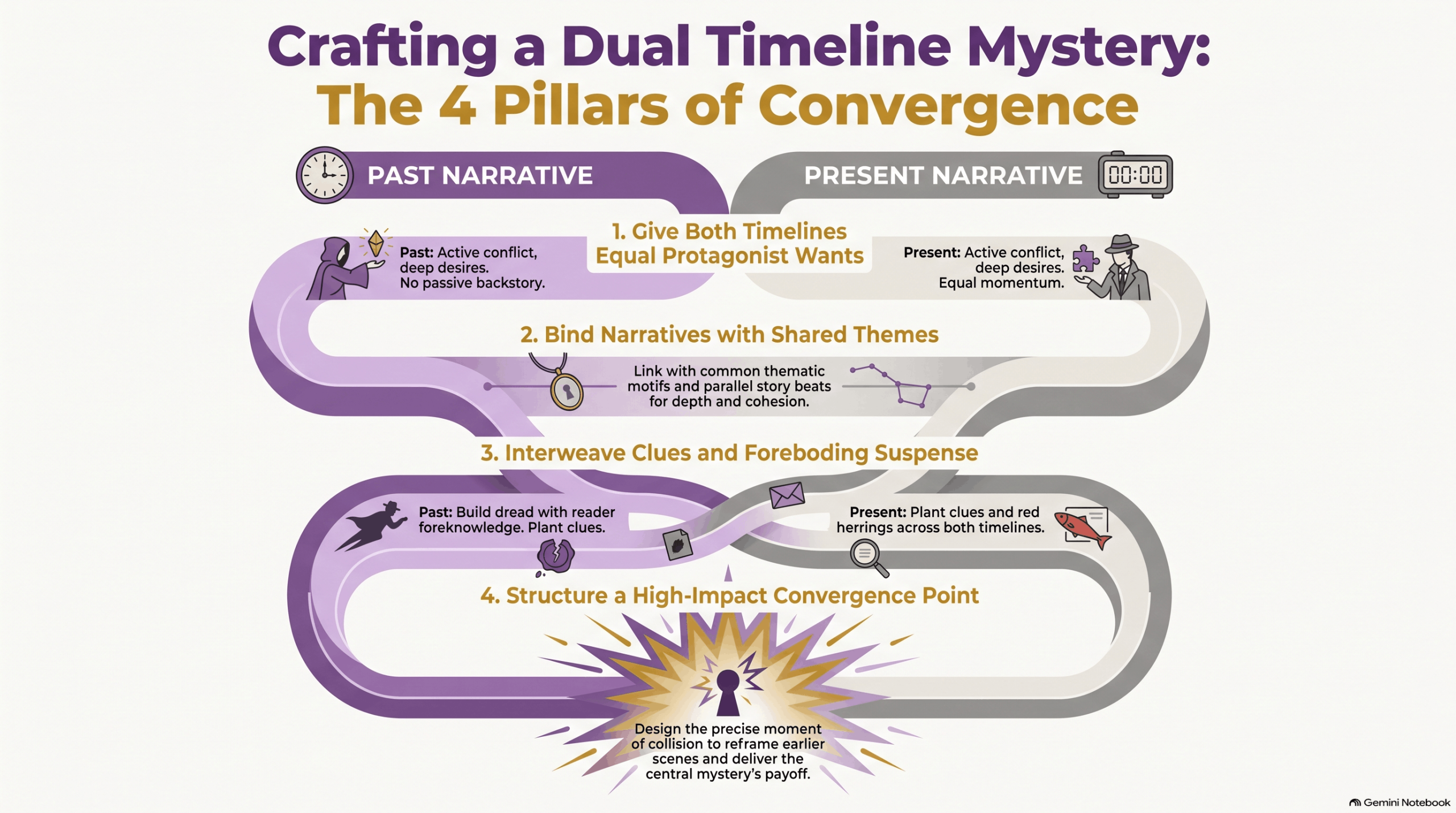
2. Give the past a story worth following
A past chapter needs a reason to hold our attention beyond supplying background.
For example: what does Leah want before she disappears? What stands in her way? What choices does she make, and what do those choices cost her?
Perhaps she wants to leave town, but someone she trusts persuades her to stay for one final weekend. Her decision leads to a confrontation. Afterwards, she hides a letter and changes her plans. Now the past strand contains movement: desire, pressure, choice and consequence.
Compare that with a chapter devoted to explaining the sailing club’s history. The information may be relevant, but readers are likely to feel they’ve been taken away from the story for a briefing.
You don’t need an equally long, entirely self-contained novel in each period, but you do need purposeful progression in both strands.
When the reader knows the outcome
If the opening establishes that Leah disappears, the earlier scenes can still carry suspense. The question becomes: how will she reach that point? Who will betray her? Will she recognise the danger? What will survive to reveal the truth?
A countdown can strengthen this effect, but use it deliberately. Dating a chapter ‘Three days before Leah disappeared’ tells readers that the narrator knows where events are heading.
3. Make the present matter
A vivid past storyline can easily overshadow an investigation made up of interviews, searches and cups of tea, so give your present-day protagonist something at stake in the discovery.
Mara might believe that solving Leah’s disappearance will clear their mother’s name. But the photograph suggests their mother concealed something. Pursuing the truth could damage the very person Mara wants to defend. That gives the investigation an emotional direction as well as a factual one.
Personal stakes don’t have to mean a traumatic backstory or a family connection. A professional commitment, a threatened friendship or a conflict between loyalty and duty can all make the search matter.
Nor must the intensity of the two strands match scene for scene. What matters is that returning to either strand feels worthwhile.
Ask:
- What does my present-day protagonist want?
- What will they lose if they stop?
- What might they lose if they succeed?
- How does each discovery change their next decision?
That final question is particularly useful. If your protagonist receives information but keeps following the same plan, your investigation may be collecting facts without developing.
4. Choose where the strands connect
The past and present don’t need to share page space equally, and alternating chapters isn’t compulsory. Choose the arrangement that best controls understanding and anticipation.
| Approach | How it works | What to watch for |
|---|---|---|
| A major midpoint connection | A past scene changes how readers interpret the present investigation around the middle | The revelation needs consequences in the later chapters |
| Connections throughout | Earlier scenes and present discoveries repeatedly change the meaning of each other | Avoid showing an event and then immediately explaining it again |
| A late decisive connection | The full relationship between the strands becomes clear near the ending | Give readers enough earlier connections to understand why both strands matter |
These are planning options, not fixed formulas. Your novel might combine them.
Make each switch earn its place
A strong transition can create a question, answer one while opening another, or change the emotional meaning of what we’ve just read.
For example:
The past scene answers one question while creating another. Why must the meeting remain secret?
A transition can also work through an emotional echo. Mara’s refusal to trust an old friend might lead into a past scene showing Leah making the opposite choice.
Use these echoes where they add meaning. You don’t need a matching object, phrase or dramatic cliffhanger at every switch.
Help readers settle quickly
A date heading is often enough to establish the period. Combine it with an early indication of viewpoint and setting.
You can distinguish the strands through voice or tense if that suits your novel, but changing both isn’t a requirement. Consistent signals are more useful than a complicated system.
5. Plant clues without breaking reader trust
For a puzzle mystery, the ending is more satisfying when readers can look back and recognise the foundations of the solution. That doesn’t mean explaining every clue as it appears. A detail can be visible while its significance remains uncertain.
In our example, Leah’s bracelet might initially suggest a secret relationship. Later, a photograph could establish who gave it to her. Its engraving might finally connect it to a particular place.
The detail stays the same; its meaning develops.
Sort clues by function
Rather than treating clue placement as a rigid four-tier system, label what each detail does in your particular draft.
| Function | Example | Revision question |
|---|---|---|
| Raises a question | Leah wears an unfamiliar bracelet | Will readers notice it without being told it must matter? |
| Supports or challenges an account | A photograph contradicts a witness’s description | Does it change what the investigator does? |
| Connects earlier information | The engraving matches a club insignia | Has the relevant context been established? |
| Helps establish the solution | A corroborated record places someone where they denied being | Is its discovery credible, and does it support the conclusion claimed? |
One clue can serve several functions. Not every atmospheric detail needs to become evidence, and your ending needn’t depend on a single piece of decisive proof.
Can the past storyline mislead the reader?
Yes. A past viewpoint character can misunderstand events, believe a lie or give an unreliable account. Documents can also be deceptive.
If a close viewpoint character recognises the person entering a room and repeatedly calls them ‘the figure’ purely to conceal their identity, it can feel artificial. Ask yourself: would this character think about them this way if I wasn’t trying to preserve a twist?
6. Build a timeline you can actually check
Before arranging the reveals, make a chronological record of the relevant events.
Include the unglamorous details: travel, access, phone calls, who possessed an object and when someone could have learned a secret. Then distinguish how each time is known.
| Time category | Example | What to check |
|---|---|---|
| Recorded | A timestamped photograph | Is the clock accurate, and what does the record actually establish? |
| Reported | A witness says Leah left at eleven | Could they be mistaken or lying? |
| Estimated | Someone places an event within an approximate window | How broad is the uncertainty? |
| Unknown | A letter was removed sometime that weekend | What events limit the possible window? |
These are useful planning labels, not a formal forensic standard.
A timestamp records something, but it doesn’t necessarily prove who was present or what happened. Make the strength of your fictional evidence match the conclusion drawn from it.
Research technology around the actual case
Avoid assuming that a present-day investigator can solve an old crime immediately through DNA, phone records or CCTV. Equally, don’t make technology disappear simply because it inconveniences the plot (which it often does).
Research the period, jurisdiction and evidence involved. Establish plausible limits such as whether a record was ever created, whether it survives and whether it can answer the relevant question.
For a closed case, ask why the original conclusion appeared convincing and what now makes reconsideration possible. An overlooked lead or mistaken assumption may be enough; it doesn’t have to be some institutional conspiracy.
7. Revise the strands separately, then together
Here’s a practical sequence for checking a completed draft.
Pass one: Read the past strand on its own
Follow the earlier chapters in their intended internal order. Colour coding your past and present strands works well for visual writers.
Check character motivations, continuity, escalating pressure and the consequences of decisions. Flag scenes that exist only to deliver information to the other strand.
Pass two: Read the present strand on its own
Does the investigation make sense without the reader’s privileged access to the past?
Mara cannot act on something only the reader has seen. Every decision needs a basis available to her, even if that basis is incomplete or mistaken.
Pass three: Track who knows what
Create a simple information ledger.
| Chapter | Reader learns | Investigator knows | Remaining question | Effect on the story |
|---|---|---|---|---|
| Present: photograph found | Leah wore the bracelet | Mara sees the same photograph | Where did it come from? | Mara revisits a witness |
| Past: secret meeting | Someone gave Leah the bracelet | Mara still doesn’t know this | Why was the meeting hidden? | Readers reassess the witness |
| Present: witness changes account | The first account was incomplete | Mara recognises the contradiction | What else has been concealed? | She follows a different lead |
Reader knowledge doesn’t always destroy suspense. If readers know a suspect is dangerous before Mara does, concern for her may become the source of tension.
The problem arises when the reader already knows the answer and the intervening investigation offers no fresh uncertainty, consequence or emotional development.
Pass four: Check the switches
At each transition, ask:
- Why am I leaving this strand here?
- What does the next scene contribute?
- Am I repeating information or changing its meaning?
- Have I left a strand unattended long enough for readers to lose their connection?
Pass five: Test the ending backwards
Once you know the final truth, retrace the supporting details.
Check that the explanation fits the chronology, clues and character behaviour. Then look for loose ends that are accidental rather than deliberately unresolved.
Your Homework!
Your Dual-Timeline Checklist
Before you move on to polishing sentences, check:
- ☐ Experiencing the past adds something important to the novel.
- ☐ Each strand contains developing conflict and consequential choices.
- ☐ The present investigation matters beyond assembling facts.
- ☐ Readers can identify the period and viewpoint quickly.
- ☐ Timeline switches contribute a question, consequence or changed understanding.
- ☐ The underlying chronology works.
- ☐ Clues support the conclusions drawn from them.
- ☐ Reader knowledge and investigator knowledge remain distinct.
- ☐ Concealment fits the viewpoint and narrative approach.
- ☐ The ending rewards attention to earlier scenes.
FAQs
Does a dual-timeline mystery need to alternate chapters?
No. You can alternate regularly, group chapters or vary the pattern. Establish a clear approach, then make switches according to the needs of the story.
Must the past and present have different protagonists?
No. You can follow the same person at different ages. Make it clear when we are and how the character’s knowledge, priorities or circumstances have changed.
Should both timelines have the same word count?
No. Give each strand enough space to fulfil its purpose. A shorter past strand can be powerful if its scenes make an essential contribution.
Can the reader discover the culprit before the detective?
Yes. The suspense may then centre on how the investigator will uncover the truth, whether they will survive, or what proving it will cost. Check that the remaining story still offers something readers want to experience.
Do the timelines have to meet literally?
No. Characters from the two periods don’t have to encounter each other. The strands can connect through a discovery that changes how readers understand the earlier events and their present consequences.
Bring the Past and Present into Focus
Need help untangling your crime manuscript? A developmental edit or manuscript evaluation can help you identify where the structure, investigation and character decisions need closer attention.
Further reading
For additional author perspectives on managing narrative strands: