The Ultimate Scene Tension Checklist: 30 Questions to Strengthen Every Scene
Quick Answer
Scene tension comes from characters wanting something, facing meaningful conflict, making difficult choices and leaving readers desperate to know what happens next. Use this checklist during self-editing to make sure every scene earns its place in your novel.
Why Writers Need a Scene Checklist
One of my mantras is: “Never edit your own work”. Don’t take this literally, you need to edit your first draft, and even a few drafts after that, but the final edit should be performed by someone who has never read your novel.
Why? Because, after spending months (or years) creating each sentence and scene, we become blind to the words on our manuscript. Our brain fills in any blanks for missed words, autocorrects any bad grammar, and ignores the lack of tension within the scene.
How to Use This Checklist
By now you’re probably pen-poised and excited to improve the tension in your scene, but let me explain a couple of things first.
You do not need to tick every box!
Writing is a creative process which needs freedom and expression to thrive. The checklist is based on the success of millions of novels, so it’s helpful to know whether your scene has tension or not based on the data, but it isn’t something you need to stick to rigidly.
Don’t forget genres conventions. If you’re writing a mile-a-minute thriller, you’re going to want plenty of high-tension scenes as this is what your genre conventions dictate, and what your readers are expecting. On the other end of the genre spectrum, if your novel is an historical romance, there will be more quiet scenes. Quiet scenes can be just as powerful, but we’ll discuss that in another article.
Every Scene Matters
💜 Readers don’t remember every sentence.
❤️ They remember how each scene made them feel.
📖 If enough scenes feel flat, readers stop turning the pages.
The Checklist
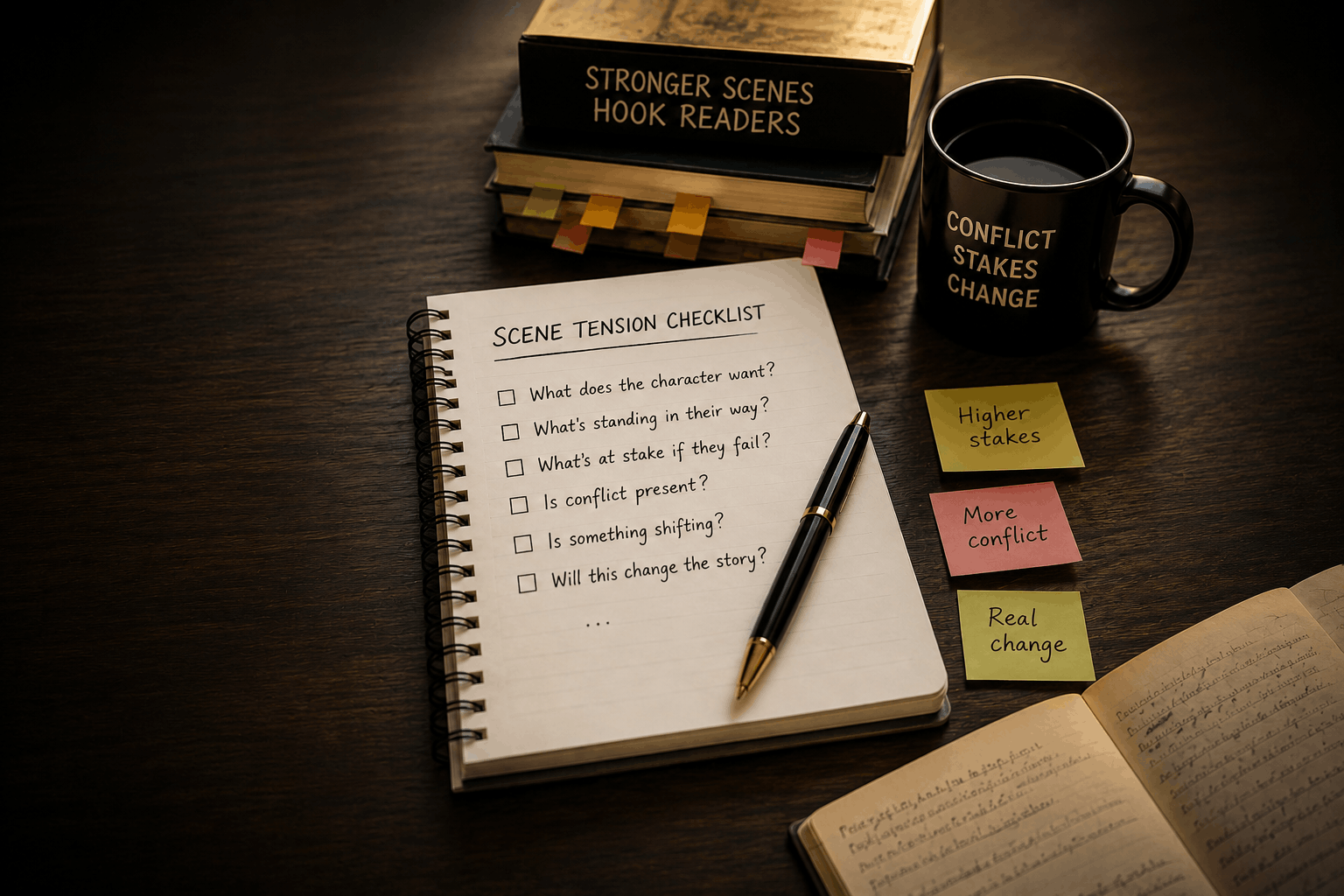
Use this checklist whenever you’re revising a scene. You can paste it into your favourite online notepad, print it out, or keep it beside your desk whenever your characters start being just a little too agreeable.
🎯 Goals and Choices
☐ Does every major character want something specific in this scene?
☐ Is there genuine conflict rather than simply an obstacle?
An obstacle slows a character down. Conflict forces them to make a difficult choice.
☐ Is there a clear scene question?
For example: Will she confess? Will they escape? Will the detective find the missing clue?
☐ Is your protagonist making active choices rather than simply reacting to events?
☐ Does every decision create a new problem or consequence?
💜 Curiosity and Microtension
☐ Have you avoided predictable emotional reactions? Example. Ask: What is expected? Then do the opposite.
☐ Do your descriptions add emotional weight rather than simply describing the setting? Use all five senses.
☐ Is there something unexpected that keeps the reader curious?
☐ Are there moments where the reader wonders, “What the…?” or “Why did they do that?”
☐ Does each page contain something that encourages the reader to keep going?
❤️ Internal and External Conflict
☐ Does the external conflict connect to your character’s internal struggle? E.g., Is she ignoring his advances because she’s scared to love again?
☐ Are outside events forcing your character to confront a fear, flaw or false belief?
☐ Are your character’s desires competing with their fears?
☐ Is the emotional tension just as strong as the physical tension?
💬 Dialogue and Subtext
☐ Are your characters saying exactly what they mean?
If they are, could the conversation become more interesting through subtext?
☐ Does the listener misunderstand, misinterpret or bring their own emotional baggage to the conversation?
☐ Do different personalities naturally create friction? Think cynical detective and psychic consultant.
☐ Are there interruptions, evasions or unfinished thoughts that create tension?
☐ Does every conversation change something?
🔍 Secrets, Stakes and Suspense
☐ What information is each character missing?
☐ Does the reader know something at least one character doesn’t?
☐ Are the consequences of failure clear?
☐ Is there something important to lose?
☐ Is there any form of time pressure, deadline or approaching event increasing the urgency?
⚡ Pacing
☐ Does the pace match the emotional intensity of the scene?
☐ Have you removed unnecessary explanation or repetition?
☐ Are long passages broken up with dialogue, action or interior thoughts?
☐ Does each paragraph move the story forwards?
📖 Ending the Scene
☐ Does the scene end with momentum?
☐ Have you answered the scene question while introducing a new one?
☐ Does something change before the scene finishes?
☐ Will readers immediately want to read the next chapter?
❤️ Writer Tip
You don’t need every box ticked in every scene.
Quiet scenes can still be full of tension. A difficult conversation over coffee can be just as gripping as a car chase if readers know what’s at stake.
Aim to create curiosity, conflict and emotional investment. If your readers are desperate to know what happens next, your scene is doing its job.

| Common mistake | Try this instead |
|---|---|
| Trying to make every scene action-packed. | Build curiosity, emotional pressure or a difficult choice. |
| Mistaking obstacles for conflict. | Make the character choose, risk or lose something. |
| Explaining emotions instead of creating them. | Let readers feel the tension through action, dialogue and subtext. |
| Ending scenes after everything has been resolved. | Answer one question while opening another. |
| Forgetting the character’s internal conflict. | Connect the outer problem to the character’s fear, flaw or desire. |
Need Help With Any Part of Scene Tension?
Need help on any of the aspects mentioned in the checklist? You’ll find more information about each subject in the articles listed below.
Your Homework 📖
Take one scene from your current manuscript.
Work through the checklist honestly.
Highlight three boxes you couldn’t tick.
Revise the scene focusing only on those three points.
Compare the new version with the original and notice how much more momentum the scene has.
Start on the next scene.
Still Unsure Why Your Scenes Aren’t Working?
A professional developmental edit doesn’t just point out flat scenes, it explains why they aren’t working and shows you how to strengthen them while keeping your unique voice. I’m always happy to chat about your manuscript before you make any decisions.
Frequently Asked Questions
Can every scene have tension?
Yes, but tension does not always need to be loud or dramatic. A quiet conversation, a private realisation or a moment of hesitation can all create tension if something important is at stake.
Does tension always mean conflict?
No. Conflict is one way to create tension, but curiosity, secrets, uncertainty, emotional vulnerability, difficult choices and time pressure can also keep readers engaged.
How many goals should a scene have?
Most scenes work best when the main character has one clear goal. Other characters may have their own goals too, and that is often where the tension begins.
Can dialogue create tension on its own?
Yes. Dialogue can create tension through subtext, misunderstanding, avoidance, interruptions and the gap between what a character says and what they really mean.
When should I use this checklist?
Use this checklist during revision rather than while drafting. It is especially useful when a scene feels flat, slow, predictable or disconnected from the rest of the story.