Why Developmental Editing Isn’t Tearing Your Book Apart
If the words ‘developmental edit’ make your stomach tighten a little, you’re not alone.
Many writers, especially first-time authors, feel a surge of nerves at the thought of someone pulling their manuscript apart. You have poured months, sometimes years, into your story. You have lived with these characters. You have shaped every twist, every confession, every reveal.
Of course it feels personal.
But here’s the truth. Editing is not a demolition job. It’s a strengthening process. And when it’s done well, it feels collaborative, not corrective.
Let’s talk about why it can feel scary, and what is really happening beneath the surface.
Why Editing Feels So Personal
A manuscript is not just a document. It’s time, emotion, identity and effort woven into 80,000 (or so) words. I’ve had many authors refer to their manuscripts as ‘my baby’. Funnily, it’s mostly male authors who use that description.
When feedback arrives, it can land like judgement. Even when it’s thoughtful and kind, it can still trigger that quiet voice that whispers, ‘maybe I’m not good enough’.
There’s also a stubborn myth floating around that good writers should not need editing. As if real talent means getting it perfect on the first attempt. Wouldn’t that be nice?
Unfortunately, that’s not how books are made.
Even bestselling authors work closely with editors. Structural work, pacing tweaks, character deepening, sharpening tension – this is part of the professional writing process. It’s not a sign of failure. It’s a sign that you care about your reader.
In September 2025, the lovely Susie Dent, lexicographer and Countdown star, was a special guest at the Chartered Institute of Editing and Proofreading (CIEP) annual conference. Susie is used to working with editors on her many non-fiction books, but declared working with her fiction editor to be a whole different experience. She spoke warmly of the skill and dedication her editor had brought to shaping the novel into its best possible form. If you love a mystery, check out Guilty by Definition by Susie Dent.
Genre plays a big part in the editing process. If you’re writing crime, mystery, thriller or romance, readers have strong expectations. They want satisfying tension, emotional credibility, earned twists and a payoff that feels both surprising and inevitable. Shaping a manuscript to deliver that consistently is craft work. No one masters that alone.
What Developmental Editing Actually Does
Developmental editing is not about circling commas or changing your voice.
It looks at the big picture.
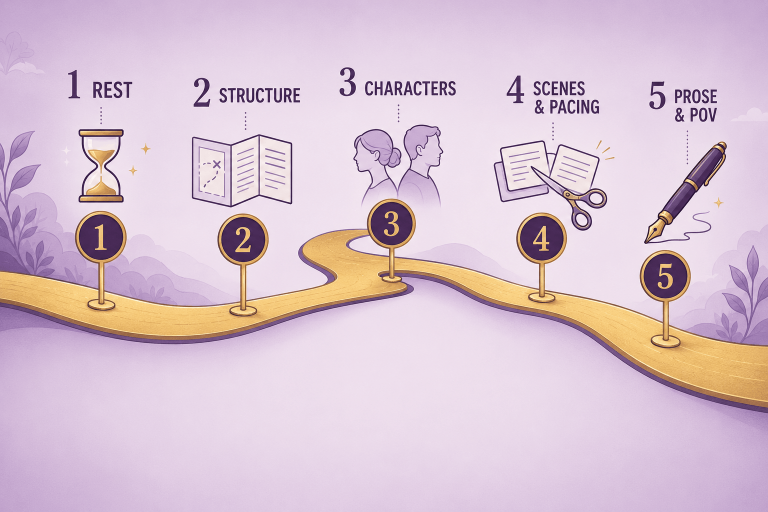
- Is the plot logically structured?
- Does the pacing hold tension where it needs to?
- Are character motivations clear and believable?
- Do scenes move the story forward?
- Does the emotional arc feel earned?
In crime fiction, that might mean tightening clue placement or ensuring the reveal lands with impact. In romance, it might mean strengthening emotional beats so the relationship feels convincing and deeply satisfying.
A good developmental edit doesn’t simply point at problems, it shows you why something is not landing and gives a practical example so you can see how to fix it.
You’re not handed a list of faults. You’re given guidance.
That difference matters.
How the Right Editor Makes It Safer
The experience of editing depends enormously on the editor.
The right editor explains what they are seeing in clear, calm language. They show examples in context. They outline priorities so you’re not overwhelmed by everything at once.
And crucially, they make space for conversation.
A follow-up discussion can transform how feedback feels. Instead of staring at comments alone, you can ask questions, test ideas and gain clarity about your next steps. The process becomes collaborative.
The goal is not just to improve your manuscript, it’s to strengthen your understanding of structure, pacing and character so that your next book starts at a higher level.
That’s where confidence grows.
When you understand why changes are needed, you become a stronger storyteller. Editing shifts from something done to you into something you actively use.
A Final Thought
Editing is not about proving you wrong. It’s not a game of one-upmanship. It’s a collaborative process.
It’s about helping your story land powerfully with readers. It’s about ensuring the tension grips, the romance resonates and the ending satisfies.
Your voice stays yours. The structure simply becomes stronger. The emotional impact becomes clearer. The reader experience becomes smoother.
If you’re feeling unsure about whether your manuscript is ready for developmental editing, you’re welcome to book a manuscript discussion. Sometimes a conversation is all it takes to replace anxiety with a clear plan.
Your book doesn’t need to be broken to benefit from editing. It just needs the right support to become the strongest version of itself.