
How to Choose the Right Story Structure for Your Novel
You’ve heard of the three-act structure, Save the Cat! and the Hero’s Journey. Perhaps you’ve downloaded beat sheets, studied diagrams and tried to work out which system your novel is supposed to follow.
The problem is that knowing the names of several story structures doesn’t necessarily help you choose one. A framework that gives one writer a reassuring sense of direction can leave another feeling restricted, confused or convinced that their novel is somehow wrong.
In this guide, we’ll look at some popular story structures, but we won’t begin with the frameworks. We’ll begin with your story. You’ll identify what creates its momentum, how much guidance you need and where you are in the writing process. At the end, there’s a practical Story Structure Fit Test to help you choose a useful starting point.
Quick Answer
The right story structure is the one that helps you see, develop or repair the most important movement in your novel. If your story is driven by external conflict, internal transformation, a developing relationship or the gradual revelation of truth, you may need a framework that gives particular attention to that element.
You don’t have to force every part of your novel into one template. Choose one primary structure for the overall shape, then use a secondary framework only if it helps you track another important layer, such as a romance, mystery or character arc.
Why Is Choosing a Story Structure So Confusing?
Search for advice about structuring a novel and you’ll quickly encounter a long list of systems. Some divide a story into three acts. Some use seven turning points. Others provide fifteen beats, twelve stages or a curve showing the rise and fall of dramatic tension.
It’s exhausting!

The terminology can make these frameworks appear more different than they are. One structure might refer to an ‘inciting incident’, another to a ‘catalyst’ and another to a ‘call to adventure’. Each phrase has its own nuances, but all three describe a disruption that draws the protagonist away from their established life and into the central story.
Choosing becomes even harder when advice is presented as a set of rules:
- Your inciting incident must happen at a particular percentage.
- Your protagonist must refuse the call.
- Your midpoint must contain a false victory or false defeat.
- Your novel must include every named beat.
Specific guidance can be very useful, particularly when you’re planning commercial fiction or trying to diagnose a pacing problem. However, it becomes unhelpful when you begin inventing events purely to satisfy a template.
Don’t choose a story structure because it’s popular or commonly used in your genre. Choose the framework that best supports what keeps your reader turning the pages.
The purpose of structure isn’t to make your story resemble everybody else’s. It’s to help you organise your individual plot, characters and conflicts so that the reader experiences a developing sense of movement and meaning.
Start With Your Story’s Engine
Your story engine is the main source of its momentum. It’s the question, goal, conflict or developing situation that makes the reader want to know what happens next.
Most novels contain more than one type of movement. A crime novel may also contain a love story and a significant character arc. A romance may involve an external threat, family conflict or a mystery. The important question is: which movement forms the novel’s central spine? When I’m working with an author on a developmental edit, the first thing we discuss is what is it that will keep their readers engaged throughout the story? This way, it’s always in the back of their mind when it comes to rewrites.
An External Goal or Threat
The protagonist must achieve something, prevent something or survive something. Their decisions create consequences, the obstacles become more difficult and the stakes rise as the story develops.
This engine is common in thrillers, adventures, fantasy quests and action-led crime fiction. Broad turning-point frameworks such as the three-act or seven-point structure can help you track the protagonist’s progress towards the goal.
An Internal Transformation
The reader is invested in how the protagonist’s experiences will change them. External events still matter, but their greatest purpose is to challenge the character’s beliefs, fears, weaknesses or understanding of themselves.
The Hero’s Journey may help you connect the external journey with the internal one. However, it isn’t the only choice for character-led fiction, and not every protagonist needs to return home carrying a metaphorical elixir.
A Developing Relationship
The story’s momentum comes from the changing relationship between two or more characters. Each interaction alters their understanding, trust or emotional vulnerability.
In a romance novel, readers are asking how the central couple will overcome the internal and external obstacles preventing them from being together. A romance-specific beat structure can help you track this emotional progression more closely than a general plot framework.
A Mystery or Gradual Revelation
The reader keeps turning the pages because they want to understand what happened, why it happened or what a character is hiding. The order in which information is revealed becomes a vital part of the structure.
This is central to mysteries and many crime novels, but it can also drive psychological, Gothic and literary fiction. You may need a framework that helps you manage clues, discoveries, false interpretations and revelations rather than one based entirely on physical action.
A Succession of Escalating Crises
Some stories create momentum by placing the protagonist under almost continuous pressure. Each crisis leads quickly to another, leaving little time for the situation to return to normal.
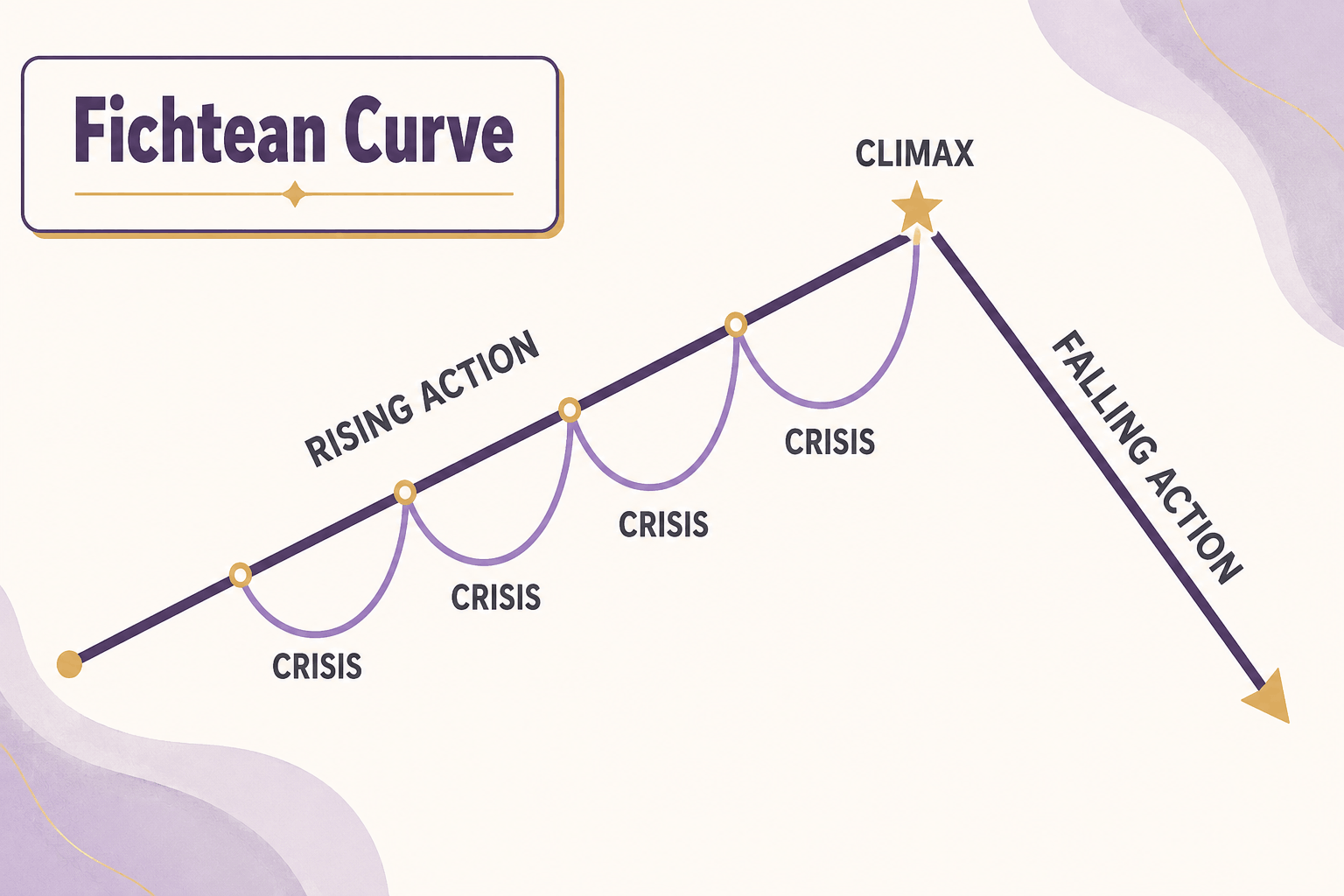
The Fichtean Curve can be useful for thrillers, suspense and other fast-moving stories because it begins close to the conflict and builds through a series of increasingly serious crises.
Multiple Characters or Storylines
Ensemble and multi-viewpoint novels may not have one obvious protagonist journey. Their structure may be formed by a shared event, theme, place, relationship or gradually converging plotlines.
You can still use a broad framework to track the novel’s overall movement, but each important storyline may also need its own smaller arc. The challenge isn’t finding a template with enough boxes. It’s making sure the different strands influence each other and contribute to the whole.
Simple Writer Tip
Complete this sentence: ‘My reader will keep turning the pages because they want to know…’ Your answer will often reveal the story’s main engine more clearly than its genre label.
What Are the Most Popular Story Structures?
The following summaries aren’t intended to cover every stage of every framework. They’ll help you understand the type and amount of guidance each one provides.
The Three-Act Structure
The three-act structure divides the story into three broad sections: setup, confrontation and resolution.
- Act One: Establishes the protagonist, their world and the central disruption.
- Act Two: Develops the conflict through obstacles, discoveries, decisions and rising stakes.
- Act Three: Brings the conflict to a climax and shows the consequences.
Its strength is its flexibility. It can give you an overall shape without dictating every stage of the journey. Its weakness is that ‘develop the conflict’ isn’t always enough guidance when you’re staring at the enormous middle of a novel and you look like the writer in the earlier image.
It may suit you if: you want a flexible overview, you already have a strong sense of your scenes, or detailed beat sheets make you feel restricted.
Save the Cat!
Originally developed by Blake Snyder for screenwriting and later adapted for novels by Jessica Brody, Save the Cat! uses fifteen named beats. These include the Opening Image, Catalyst, Debate, Break into Two, Midpoint, All Is Lost and Finale.
The beats help writers think about both the major turning points and the sections between them. Suggested percentages can also make pacing problems easier to spot.
Its strength is its specificity. Its weakness is that writers can become so concerned with reaching each beat at the ‘correct’ point that the characters’ actions begin to feel engineered.
It may suit you if: you enjoy detailed planning, you’re writing strongly paced commercial fiction, or you need help working out what should happen between the major turning points.

The Hero’s Journey
The Hero’s Journey follows a protagonist who leaves their familiar world, faces trials, undergoes a significant ordeal and returns changed. Modern versions often use stages such as the Ordinary World, Call to Adventure, Crossing the Threshold, Ordeal and Return.
Its strength is the connection between external events and internal transformation. Its mythic language can also unlock creative ideas. Its weakness is that the stages may feel unnatural when applied too literally to quieter, ensemble or non-transformational stories.
It may suit you if: your protagonist’s transformation is central, the story involves entering an unfamiliar world, or the external plot reflects an important internal struggle.
The Seven-Point Story Structure
The seven-point structure concentrates on the Hook, Plot Turn One, Pinch Point One, Midpoint, Pinch Point Two, Plot Turn Two and Resolution.
It encourages the writer to identify the ending and major turning points before filling in the journey between them. The pinch points are particularly useful for checking that pressure from the central conflict is felt throughout the novel.
Its strength is that it offers more direction than three acts without becoming as detailed as a fifteen-beat system. Its weakness is that the spaces between those seven points may still need considerable development.
It may suit you if: you plan around major turning points, you know the ending, or you want a manageable framework that still pays attention to pressure and escalation.
The Fichtean Curve
The Fichtean Curve begins close to the action and develops through a series of crises. Each one increases the pressure until the story reaches its climax, followed by a relatively brief resolution.
Its strength is urgency. Its weakness is that limited setup and frequent crises may not suit a story that needs space for reflection, gradual world-building or subtle relationship development.
The Wizard of Oz is an example of a novel which uses the Fichtean Curve, as is Star Wars: A New Hope.
It may suit you if: your story is driven by danger, urgency or escalating problems, and you want to reduce a slow opening or sagging middle.
Genre-Specific Beat Structures
General story structures describe the overall movement of a narrative. Genre-specific frameworks concentrate on developments that create a satisfying experience for a particular readership.
A romance structure may track the first significant connection, growing attraction, deepening emotional intimacy, separation and eventual commitment. A mystery structure may track the crime, investigation, clues, suspects, reversals, revelation and confrontation.
Their strength is their attention to reader expectations. Their weakness is that a genre beat sheet may not fully support the novel’s internal character arc or external subplot.
They may suit you if: the genre-specific journey is the main reason readers will choose the novel, or you need to check whether that journey develops throughout the story rather than disappearing for long sections.
How Much Structural Guidance Do You Need?
The right structure doesn’t depend only on the story. It also depends on how you work.
Some writers feel calmer when they can see fifteen beats and approximate pacing points. Others lose interest in writing the novel once every development has been planned. Neither approach is more professional or creative. The useful question is how much planning helps you move forwards before it begins to interfere with discovery.
| Your preference | A useful starting point |
|---|---|
| You want the loosest possible shape. | Use the three-act structure and identify only the central disruption, midpoint, climax and resolution. |
| You like a small number of firm signposts. | Try the seven-point story structure. |
| You enjoy detailed planning and pacing guidance. | Try Save the Cat! or a detailed genre beat sheet. |
| You discover the story while writing. | Draft freely, then use a broad framework to diagnose gaps during revision. |
| You think about character before plot. | Try the Hero’s Journey or map the character arc alongside a simple three-act structure. |
Important
A complex framework isn’t automatically more effective than a simple one. The best structure is the simplest framework that helps you answer the questions your manuscript is currently asking.
When Will You Use the Structure?
A structure can serve different purposes at different stages of writing. You don’t necessarily need the same tool for planning and revision.
Before the First Draft
At the planning stage, a structure can help you turn an idea into a sequence of connected developments. Choose a framework that gives you enough direction to begin without requiring you to invent details you’d rather discover on the page.
A detailed planner might use Save the Cat! to create a scene outline. A looser planner might identify three acts and four or five turning points. And a ‘Pantster’ might say ‘To hell with it! Let’s see where this character takes me.’ 😀
During the First Draft
If you become stuck, structure can help you look beyond the next scene. Rather than forcing the draft back onto a predetermined path, ask which important movement has stalled.
- Has the protagonist stopped pursuing a meaningful goal?
- Has the central threat disappeared?
- Has the relationship stopped changing?
- Has the investigation stopped producing discoveries?
- Has the protagonist avoided making difficult decisions?
Your answers may be more helpful than asking which beat is supposed to happen next.
During Revision
Once the complete draft exists, structure becomes a diagnostic tool. You can compare the story you’ve written with one or more frameworks to reveal missing turns, repeated developments or sections in which the central engine loses momentum.
This doesn’t mean rewriting the manuscript until it matches every beat. It means using the framework to ask better questions.
Example
A writer notices that the middle of her crime novel feels repetitive. A seven-point structure shows that the investigation contains several clues but no strong midpoint development. The detective learns new information, yet nothing changes their understanding of the crime.
The solution isn’t simply to place a dramatic event at the 50 per cent mark. The writer needs a discovery, decision or reversal that changes the direction of the investigation and makes the detective’s previous approach inadequate.
Which Story Structure Might Help Your Novel?
| If you need help with… | Try starting with… | Why it may help |
|---|---|---|
| Seeing the novel’s overall shape | Three-act structure | Provides broad structural signposts without prescribing every scene. |
| Creating a detailed commercial-fiction outline | Save the Cat! | Offers specific beats and suggested pacing markers. |
| Developing the protagonist’s transformation | Hero’s Journey | Connects external events with internal change. |
| Strengthening major turns and rising pressure | Seven-point story structure | Concentrates attention on turning points, pinch points and resolution. |
| Creating urgency and escalating conflict | Fichtean Curve | Builds through a succession of increasingly serious crises. |
| Tracking a developing love story | Romance beats | Follows changes in attraction, trust, vulnerability and commitment. |
| Managing clues and revelations | Mystery-specific framework | Helps control what the protagonist and reader know, and when they know it. |
The Same Story Movements in Different Structures
Story structures can look incompatible because they use different names and divide the narrative into different numbers of stages. Underneath the terminology, many are drawing attention to similar movements.
| Story movement | Three-act structure | Save the Cat! | Hero’s Journey |
|---|---|---|---|
| The established world is disrupted. | Inciting incident | Catalyst | Call to Adventure |
| The protagonist commits to the central story. | First plot point | Break into Two | Crossing the First Threshold |
| A major development changes the protagonist’s direction or understanding. | Midpoint | Midpoint | Approach or Ordeal |
| The protagonist experiences severe defeat or pressure. | Crisis or second plot point | All Is Lost | Ordeal |
| The central conflict reaches its decisive confrontation. | Climax | Finale | Resurrection and Return |
These aren’t exact translations. Each framework emphasises different aspects of the journey, and individual teachers may define the stages differently. However, seeing the overlap can stop you feeling that you must discover the one correct system before you’re allowed to write.
Instead, ask which language makes your story easier for you to understand. One writer may connect immediately with ‘Crossing the Threshold’, while another finds ‘First Plot Point’ clearer. The label matters far less than the meaningful change it represents.
Can You Combine Story Structures?
Yes. In fact, many novels contain several structural layers whether the writer planned them consciously or not.
A crime-romance novel might use:
- A three-act structure for the shape of the whole novel
- A mystery framework for the investigation, clues and revelation
- Romance beats for the developing relationship
- A character arc for the protagonist’s internal change
However, combining frameworks doesn’t mean creating one enormous master checklist and forcing the manuscript to hit every beat in every system. That usually produces more confusion rather than a stronger novel.
Choose one primary framework to hold the overall story together. Add a secondary framework only when it helps you track an important movement that the primary one doesn’t show clearly.
Crime-romance example
A detective and a journalist are forced to work together on a murder investigation. The discovery of the body begins the external plot, while distrust shapes their early relationship.
At the midpoint, they discover that the apparent victim may have been using a false identity. This changes the investigation, but the same sequence also forces them to share personal information and rely on each other.
The mystery turn and relationship development don’t need separate scenes. The strongest structural moments often move more than one layer of the novel at once.
Simple Writer Tip
When combining structures, look for scenes that advance two or more layers together. A revelation might change the investigation, damage a relationship and force the protagonist to confront a personal fear. This creates cohesion rather than a collection of competing subplots.
Signs a Story Structure Isn’t Helping
A framework should make the story easier to understand and develop. It may be the wrong tool, or you may be using it too rigidly, if:
- You’re adding scenes solely to fill named beats.
- Your characters behave unnaturally because the outline requires a particular event.
- You’re more concerned about percentages than cause and effect.
- You keep renaming the same scene to make it fit different stages.
- The framework tracks the action but ignores the part of the story readers will care about most.
- You feel unable to keep a strong development because it happens in the ‘wrong’ place.
- Using several frameworks has created contradictory instructions.
- The planning system has become more complicated than the novel.
Before abandoning the framework completely, try simplifying it. Reduce it to the main disruption, key turning points, climax and resolution. Then add detail only where it helps you solve a genuine problem.
Remember that percentages are diagnostic guides rather than expiry dates. If a catalyst occurs later than a beat sheet recommends, ask how the opening holds the reader’s interest and whether the delay is purposeful. The answer may reveal a pacing problem, but the number alone doesn’t prove that one exists.
The Story Structure Fit Test
Use the following three-part test to choose a useful starting framework. You’re looking for a pattern in your answers rather than a scientifically precise score.
Part One: Identify Your Story Engine
Part Two: Identify Your Writing Needs
Part Three: Choose a Starting Point
If You Need a Flexible Overall Shape
Begin with the three-act structure. Mark the event that disrupts the protagonist’s world, the decision that commits them to the central conflict, the major change around the middle, the crisis, the climax and the resolution.
If You Want Clear Turning Points Without Too Many Beats
Try the seven-point story structure. It can help you see the movement between the beginning and ending while keeping pressure from the central conflict visible.
If You Want Detailed Guidance
Try Save the Cat!. Use its beats to generate questions and possibilities, but don’t add an event merely because a label is waiting to be filled.
If Internal Transformation Is Central
Explore the Hero’s Journey or map a character arc beside a simple three-act structure. Focus on how external pressures challenge the protagonist’s existing beliefs and choices.
If Urgency and Escalation Drive the Story
Try the Fichtean Curve. Check that each crisis changes the situation and increases the difficulty rather than simply providing another similar obstacle.
If Relationship or Revelation Drives the Story
Use a genre-specific framework for the romance or mystery layer, supported by a broader structure for the complete novel if necessary.
Your Homework!
Test the Framework Against Your Story
Choose the framework that appears to fit your story and try this exercise before restructuring the entire manuscript.
- Write one sentence explaining what makes your reader want to know what happens next.
- Identify the event that begins or significantly disrupts that movement.
- Write down three developments that increase the pressure or deepen the central question.
- Identify the moment that changes the protagonist’s direction, understanding or relationship.
- Describe the decisive confrontation or choice towards which the story is building.
- Explain what has changed by the end and why that change matters.
Now compare those answers with your chosen framework. Does it make the story’s movement clearer? Does it expose a missing connection or underdeveloped turn? Does it give you useful ideas without requiring your characters to act unnaturally?
If so, it’s probably a helpful framework. If the system draws your attention away from the novel’s central movement, try a simpler or differently focused structure.
The Best Structure Serves the Story
There is no universal story structure that will make every novel work. The three-act structure, Save the Cat!, the Hero’s Journey and other frameworks are tools for seeing and shaping narrative movement. They aren’t tests that determine whether you’re writing a ‘proper’ novel.
Begin with what keeps the reader turning the pages. Consider how much guidance supports your own writing process. Then choose the simplest framework that helps you strengthen the story’s most important journey.
You may find that one structure helps you plan while another helps you revise. You may use a broad framework for the whole novel and a more specialised one for a relationship or investigation. That’s perfectly acceptable as long as the frameworks serve the manuscript rather than compete for control of it.
The aim isn’t to make your story fit a diagram, it’s to understand the story well enough to give its most important events, decisions and changes the space and emphasis they deserve.
Need Help Untangling Your Story Structure?
If you’ve tried several frameworks and your novel still feels slow, disjointed or difficult to organise, a developmental edit or coaching session can help you identify the real structural problem.
I can help you understand what is driving your story, strengthen the connections between its plot and character arcs, and create a practical revision plan without taking control of the novel you want to write.
Frequently Asked Questions
Does Every Novel Have to Follow a Story Structure?
Every complete novel has an underlying arrangement, even if the writer didn’t consciously follow a named system. A recognisable framework can help you plan or analyse that arrangement, but you don’t have to reproduce every beat exactly.
Which Story Structure Is Best for Beginners?
The three-act structure is often a useful starting point because it provides a clear overall shape without introducing too many terms. Writers who prefer more detailed direction may find Save the Cat! easier because it offers smaller steps. The best choice depends on how much guidance helps you feel confident rather than restricted.
Which Story Structure Is Best for a Romance Novel?
A romance-specific beat structure can help you track the emotional development of the central relationship. You can combine this with the three-act or another broad structure if the novel also contains a substantial external plot.
Which Story Structure Is Best for a Crime or Mystery Novel?
That depends on what drives the novel. A thriller built around escalating danger may suit the Fichtean Curve, while an investigation may need a mystery framework that controls clues and revelations. A three-act or seven-point structure can provide the overall shape.
Can I Use Save the Cat! for a Novel?
Yes. Although Blake Snyder developed Save the Cat! for screenwriting, Jessica Brody adapted the method specifically for novelists. Its detailed beats can be useful for planning and pacing, particularly in commercial fiction.
Can I Combine the Hero’s Journey With the Three-Act Structure?
Yes. The three-act structure can show the overall movement of the plot, while the Hero’s Journey draws closer attention to the protagonist’s departure, trials and transformation. Because the frameworks overlap, you don’t need to treat every stage as a separate event.
What If My Novel Doesn’t Fit Any Story Structure?
Start with the basic movements rather than a named model. Identify what disrupts the protagonist’s situation, what they pursue, how pressure and consequences build, what decisive choice or confrontation occurs and what changes by the end. This may reveal that your novel has a less conventional structure, or it may expose connections that need further development.
Should I Choose a Structure Before Writing?
Only if planning helps you. Discovery writers can complete a first draft and use structure during revision. You can also make a very loose plan before drafting, then choose a more detailed diagnostic framework once you know what the story has become.